OpEd Project Workshops
— Spring 2025 —

The NYU Alliance for Public Interest Technology (NYUA-PIT) and OpEd Project Workshops were an exciting opportunity to expand public awareness and discourse about Public Interest Technology (PIT). Through The OpEd Project, these workshops were designed to amplify voices in public discourse by equipping scholars, experts, and emerging thought leaders with the tools to write and publish impactful opinion pieces. Through three intensive, interactive sessions, participants learned how to develop powerful ideas, establish credibility, and contribute meaningfully to public conversations across media platforms.
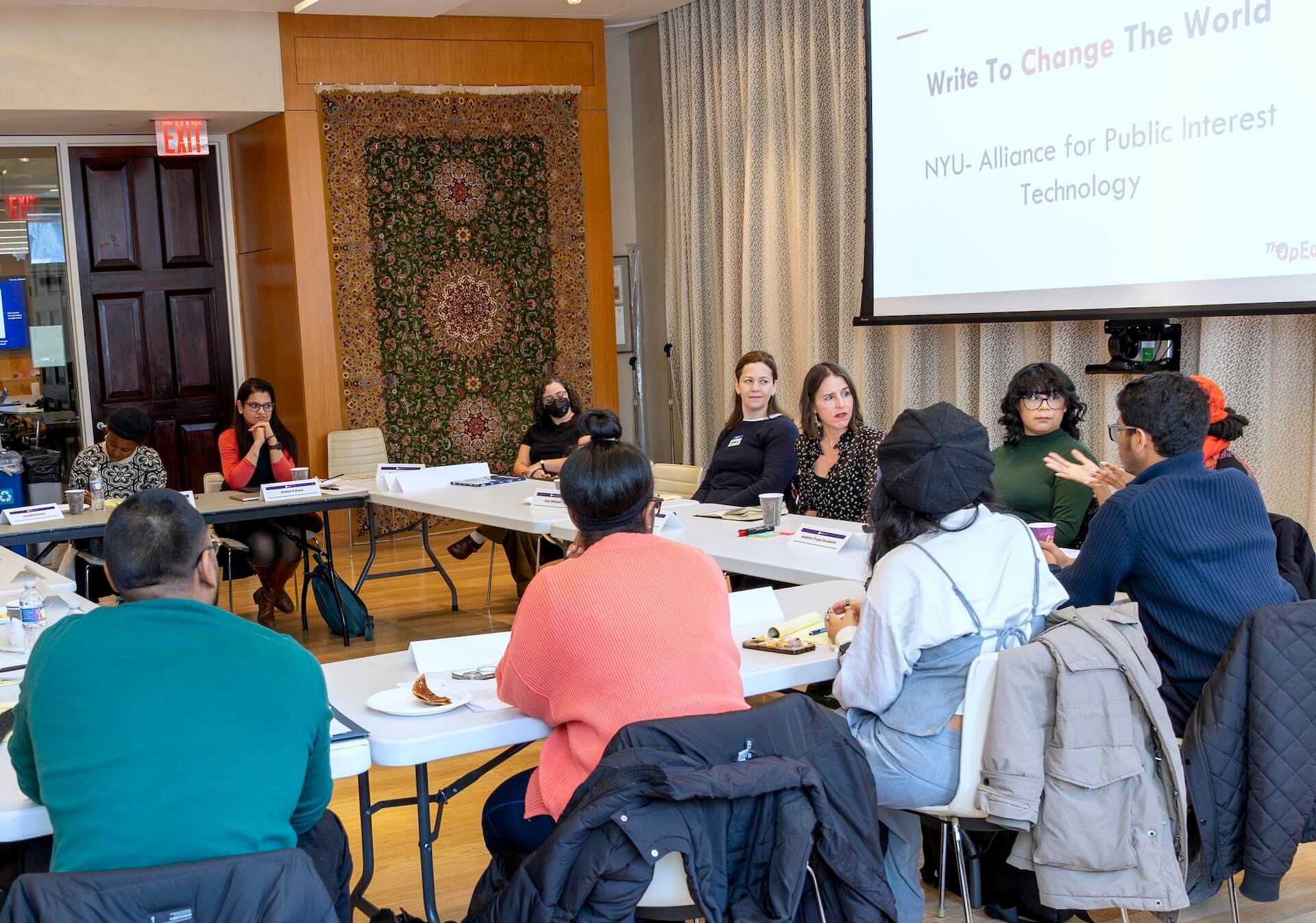
Seated workshop participants. Title on projector screen says "Write to change the world"

A reflective note from one of the participants:

This experience has been nothing short of mind-blowing. My thoughts and perspectives have expanded while I learned so much but also felt extremely seen and validated. The journey has been therapeutic and I would recommend it to anyone who values thought, knowledge and shared community.

Meet the participants

This year’s workshop participants are a dynamic group of scholars, practitioners, and students from across NYU’s diverse academic community. Each brings a unique perspective, area of expertise, and commitment to shaping public narratives in ways that inform, inspire, and drive change. Follow their work or check back here to read their OpEds and learn about the work they're doing in the field!

Amy Whitaker

Amy Whitaker

Associate Professor, Visual Arts Administration
Steinhardt School

Amy Whitaker is an associate professor at NYU Steinhardt and the author of four books: Museum Legs, Art Thinking, Economics of Visual Art, and The Story of NFTs (with Nora Burnett Abrams). Her work on fractional equity in art using blockchain received the European Academy of Management’s Edith Penrose Award for “trailblazing” research that challenges orthodoxies and has impact. Amy is at work on a new book about whether fractional equity in art and cooperative-governance experiments in the arts can generalize to creative policy design and a broader reconciling of economic and political design.

LinkedIn
Twitter/X
Anabella Afra Boateng

Anabella Afra Boateng

PhD Student
New York University

Bella Afra Boateng is a third year doctoral student in the Sociology of Education program at NYU Steinhardt. Her ultimate research goal aims to understand how Black students in urban spaces use emerging technologies in their learning and in their imagination of a future that is inclusive of their many selves and cultures. As such, she uses Black geographies, Black education traditions and technocultures to craft my emerging scholarship.

Anthoni Garcia

Anthoni Garcia

Lab Manager
CUNY

Anthoni Garcia is a graduate of the College of Staten Island with a degree in Psychology. He is the current Lab Manager at the CUNY Public Interest Tech Lab under the direction of Dr. Kathleen M. Cumiskey. He is passionate about tech ethics and making sure that tech reflects of diverse perspectives. He is looking to connect with other Latinos in the field to help empower communities through improving access to tech tools./

LinkedIn
Claudia Passos-Ferreira

Claudia Passos-Ferreira

Assistant Professor of Bioethics
School of Global Public Health

Claudia Passos-Ferreira studied psychology at the Rio de Janeiro State University and earned her MA and PhD in the program of Human Sciences and Health Sciences in Public Health there. She obtained a second PhD in Philosophy at the Federal University of Rio de Janeiro in Brazil. Passos-Ferreira has published on philosophy, psychology, and neuroethics. She has collaborated in cross-cultural research on moral development and social cognition (on topics such as empathy, fairness, ownership, intersubjectivity). She has published a book on Freud and mental causation. In philosophy of mind, she has published on self-knowledge, introspection, and external mental content. Passos-Ferreira’s current research program focuses on the development of consciousness, including what theories of consciousness say about infant consciousness and machine consciousness, and how these theories shed light on ethical issues. She is the principal investigator of the project What do theories of consciousness predict about consciousness in animals, infants, and machines? funded by Templeton World Charity Foundation.

LinkedIn
Twitter/X
Debanjan Roychoudhury

Debanjan Roychoudhury

Lecturer, Postdoctoral Fellow
Steinhardt School of Culture, Education, and Human Development; College of Arts and Science

Debanjan Roychoudhury, PhD, recently completed a two-year Andrew W. Mellon Foundation postdoctoral fellowship as part of NYU’s Prison Education Program. He received his PhD in sociology from University of California, Los Angeles in 2022. Roychoudhury’s dissertation Southside, We Outside: Policing & Placemaking in History Jamaica, Queens, New York explores the localized history of police violence, protests, and the press in the NYPD 103rd Precinct, reshaping national histories of the American War on Drugs and mass incarceration. Raised in New York City, Roychoudhury is a Posse Foundation Scholar and Leadership Alliance Mellon Initiative alumnus.

LinkedIn
Maia Woluchem

Maia Woluchem

Program Director
Data & Society Research Institute

Maia Woluchem is the director of Data & Society’s Trustworthy Infrastructures program. She is an urban planner, educator, and technologist who has worked across government, philanthropy, civil society, and in academia to preserve human rights in the digital realm. Maia is especially focused on building collective understanding around racial capitalism, democracy, and surveillance in sociotechnical systems, in both domestic and global contexts. Prior to joining Data & Society, Maia created programs, research, and funding strategy as a tech fellow at the Ford Foundation, built research at the Surveillance Resistance Lab, and did transnational advocacy work with the Coalition for Independent Tech Research. She is also an adjunct faculty member at NYU’s Wagner Graduate School of Public Service, where she teaches about segregation’s legacy on public policy. She earned a master’s degree from MIT and a bachelor’s degree from the University of Pittsburgh. [website]

LinkedIn
Bluesky
Manny Patole

Manny Patole

Industry Assistant Professor
NYU Tandon Center for Urban Science and Progress

Manny Patole is an Industry Assistant Professor at NYU Tandon’s Center for Urban Science and Progress (CUSP). With graduate degrees in engineering, law, and urban planning, his work bridges academia, community, and industry. Professor Patole specializes in applied research at the intersection of urban resilience, economic development, and civic engagement. He leads projects like Co-City Baton Rouge, a collaborative urban revitalization initiative with NYU Marron Center and LabGov. A board member of the Municipal Art Society of NYC, his teaching and research focus on fostering community resilience and sustainable development through innovative, data-driven solutions.

LinkedIn
Naeema Haque

Naeema Haque

Strategy and Planning Senior Associate
BetaNYC

Naeema is a passionate advocate for environmental justice and public interest technology. She holds a B.S. in Environmental Earth Systems Science and serves as Senior Associate on the Fellowship team at BetaNYC. A proud Bushwick native, she enjoys giving back to the community by increasing documentation of North Brooklyn’s public realm. As a strong believer in the public voice, her experience with PIT fuels her passion for intersectionality in the environment, government and technology and commitment to creating equitable, data-driven solutions for urban challenges. In her spare time, she enjoys exploring the city, hosting a book club, and working with all mediums of art and design.

LinkedIn
Nari Yoo

Nari Yoo

PhD Candidate
Silver School of Social Work

Nari Yoo, LSW, is a PhD candidate at the NYU Silver School of Social Work. Her research agenda progresses through three interconnected areas: (1) macro- and meso-level factors influencing mental health disparities among immigrant and refugee communities, including investigating systemic barriers to accessing and utilizing mental health services, (2) the role of technology in improving mental health service access and delivery for these underserved populations, and (3) data science methodologies, such as text-as-data analysis and computational social science techniques, to social work research.

LinkedIn
Raveesh Mayya

Raveesh Mayya

Assistant Professor of Technology
Stern School of Business

Raveesh Mayya is an Assistant Professor of Technology at the NYU Stern School of Business, with deep interests in digital platform policies and platform governance space. His research focuses on quantifying the impact of private policy changes made by platforms, aiming to improve governance in this space. He is particularly interested in understanding both the intended and unintended consequences of such policy changes. He also explores how Generative AI affects the supply side of platforms in the knowledge economy. His work is published in top-tier Information Systems journals such as Management Science, Information Systems Research, and MIS Quarterly and has won or received multiple nominations for best paper awards at conferences such as WISE, ICIS, CIST and AOM. He writes about his platform policy pieces at platformpolicyresearch.substack.com.

LinkedIn
Bluesky
Twitter/X
Renata Strashnaya

Renata Strashnaya

Adjunct Instructor, NYU
Adjunct Assistant Professor, Pratt

Renata Strashnaya is a developmental psychologist and an adjunct assistant professor at Pratt Institute and NYU. She teaches courses ranging from Methods of Cultural Analysis to Psychology of Women. As a narrative researcher and an advocate for ending gender-based violence, she leads projects that reframe existing narratives by prioritizing survivors’ voices and stories of vulnerability and nuance. She believes that with the agency to tell, document, and produce our own stories on our own terms, we transform our collective understanding of issues like gender-based violence beyond individual stories and create opportunities for uplifting the expertise of lived experience to change policies, mindsets, and systems.

Rohini Pahwa

Rohini Pahwa

Associate Professor
Silver School of Social Work

Rohini Pahwa is an Associate Professor and Director of the PhD Program at NYU Silver. Dr. Pahwa’s areas of specialization are severe mental illness and cross-cultural and cross-national research, and her work is rooted in her research, practice, and teaching experience in India and the United States. As a mental health researcher, Dr. Pahwa examines the process of community integration and the influences of individual and systemic factors on social networks, community integration and mental health outcomes for individuals with severe mental illnesses through qualitative, quantitative, and social network methodologies. She is currently a principal investigator on a 5-year National Institute of Mental Health funded study entitled “A Longitudinal Examination of Factors Predicting the Social Networks and Mental Health Services of Black and Latine(x) Individuals With Serious Mental Illnesses” that examines the relationships between risk and protective factors, structural, functional and experiential aspects of social relationships, and mental health outcomes for Black and Latine(x) individuals with serious mental illnesses. She earned her PhD in social work and received postdoctoral training from the University of Southern California School of Social Work. She earned her MSW from the University of Minnesota School of Social Work, her MA in psychology from Delhi University, India, and her BA from Punjab University, India. [website]

LinkedIn
Saima Akhtar

Saima Akhtar

Director
Barnard College

Dr. Saima Akhtar is the Senior Associate Director of the Vagelos Computational Science Center (CSC) at Barnard College. She is a computational social scientist with a background in architecture and software engineering. Prior to joining Barnard, Saima was a postdoctoral associate in the Yale University Department of Computer Science, where she managed digital cultural heritage preservation projects between the fields of computer science and architecture. At the CSC, Saima works with faculty and students on creatively and critically thinking about the application of computing across disciplines.

LinkedIn
Shama Patel

Shama Patel

Assistant Professor, Faculty Fellow
Stern Business School

Shama Patel joined NYU Stern School of Business as a recipient of the NYU Provost’s Postdoctoral Fellowship Award in 2024. Patel’s research explores how digital media fundamentally alter power dynamics in forming new social identities and reformed subjectivities that galvanize individuals and social movements to drive societal change. A key example of Shama’s research is her doctoral work analyzing the impact of the George Floyd video and how it organized social movements as a digitally mediatized affective contagion at scale. This study demonstrates her interest in understanding the organizing principles behind contemporary forms of activism catalyzed by digital media and how they shape civic and political participation in support of social justice and nature conservation. Her work provides valuable insights into methodological approaches and interpretive frameworks that help unfold and analyze pivotal media events as emergent digital phenomena. Before joining NYU Stern, Patel has extensive experience leading organizational change at Fortune 500 and entrepreneurial firms. As the founder of Drive Change, she has helped business leaders drive change from ideation through implementation. She has also served in leadership positions at United Airlines, Accenture and PricewaterhouseCoopers, delivering large-scale systems integration initiatives. Patel holds a PhD in Digitalization from the Copenhagen Business School, a MS in Computer Science from Northern Illinois University, and a B.S. in Geology from Delhi University.

LinkedIn
Twitter/X
Simanique Moody

Simanique Moody

Assistant Professor
The City University of New York, Brooklyn College

Simanique Moody is an Assistant Professor in the English Department and the Linguistics Program at Brooklyn College. She specializes in sociolinguistics, contact linguistics, and applied linguistics. Her research focuses on language contact, variation, and change in contact varieties spoken in North America. Dr. Moody is also engaged in research to develop and implement pedagogical methods to help students acquire standardized English without devaluing their home language and culture. Her other scholarly interests include language, culture, and identity in the African diaspora. Outside of academia, she helps increase access to educational opportunities for children in northeastern Haiti through her nonprofit work.

Suzanne Dikker

Suzanne Dikker

Research Associate Professor
FAS

Suzanne Dikker, a Research Associate Professor at NYU Department of Psychology, leads various real-world research, technology, and outreach initiatives at the interface of neuroscience, education, and digital art – with the aim to bring human brain and behavioral science out of the lab, into everyday settings. For example, MindHive is a public technology initiative that brings together students, educators, scientists, and community organizations in designing and carrying out human brain and behavioral projects; and the Harmonic Dissonance Collective creates public art/science/outreach experiences centered around neurodiversity, group cohesion, and human connectedness.

LinkedIn
Symphony Bruce

Symphony Bruce

Critical Pedagogy Librarian
New York University

Symphony Bruce (she/her) is the Critical Pedagogy Librarian at the NYU Division of Libraries where she works to align the Division’s pedagogical approaches with critical frameworks to explore how power, privilege, and oppression make an impact on our information ecosystems. Prior to her career in librarianship, Symphony was a high school English teacher, which inspired her scholarship in care ethics and student belonging. Currently, her research is working to contextualize the intersection between information capitalism and state power to build a pedagogical theory of library instruction that attends to the historical and current oppressive forces that influence how information is created, disseminated, and accessed./ope

LinkedIn
Zari Taylor

Zari Taylor

Faculty Fellow
Center for Faculty Advancement

Zari is a critical cultural studies scholar whose research focuses on the interplay between digital and popular culture. In her dissertation she explored the relationship between social media platforms, influencer culture, beauty, and race, asking how historical notions of racial value inform and are reproduced on social media and the economic stakes at play. Her broader research agenda is invested in how identity is performed and understood in digital spaces, the role of beauty capital in pop culture, and the way that technology shapes and is shaped by power dynamics.

Twitter/X